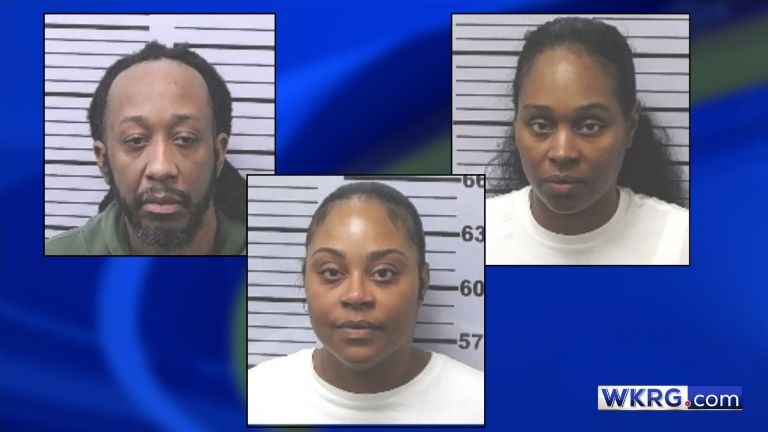
MOBILE, Ala. — Three individuals have been convicted for their roles in a multimillion-dollar drug trafficking organization operating in the Mobile area, according to the U.S. Attorney’s Office.
Federal prosecutors said Glennie Antonio McGee, 42, and his wife, Echandza Dianca Maxie, 43, led a Mobile-based drug trafficking organization that distributed large quantities of cocaine and fentanyl pills between 2017 and 2024. A third defendant, Exavieria Deagnes Maxie, 37, was convicted for her involvement in firearms trafficking and evidence tampering.
Investigators said the cocaine was supplied by cartel-connected sources in Texas and Mexico, while fentanyl pills—manufactured to resemble oxycodone—were distributed from locations in Alabama, Florida, and Washington.
During the trial, jurors reviewed extensive evidence, including wiretap recordings, surveillance footage from pole cameras, aerial units and a camera installed in McGee’s vehicle, along with text messages, financial and tax records, DNA evidence, and CCTV footage.
The investigation escalated in December 2022 after an FBI-led high-speed chase in Midtown Mobile resulted in the arrest of one of McGee’s suppliers. A subsequent search of McGee’s West Mobile home uncovered cocaine residue, large amounts of cash, custom jewelry, a money-counting machine, drug ledgers, and a Draco-style AK-47 pistol.
Although Echandza claimed ownership of the firearm, forensic testing revealed McGee’s DNA on the weapon. Investigators determined the gun was purchased by a supplier because McGee, a convicted felon, was prohibited from owning firearms. During the same search, Echandza withdrew $138,000 from multiple banks.
Homeland Security Investigations later obtained recordings of McGee describing how he laundered drug proceeds through real estate transactions. Agents documented McGee selling more than 1,000 fentanyl pills in February 2024 and intercepted approximately 8,000 drug-related phone calls during a court-authorized wiretap operation in March.
Investigators also uncovered evidence showing McGee used minors to deliver drugs and conceal evidence. In one incident, children were instructed to dispose of cocaine during a law enforcement operation, and later coached to lie to child welfare authorities.
In June 2024, agents intercepted communications about a five-kilogram cocaine shipment headed to Mobile. McGee was arrested after attempting to flee police and was found with three kilograms of cocaine. He later admitted to trafficking cocaine since 2017.
While McGee’s vehicle was under surveillance, Echandza and Exavieria were recorded attempting to hide evidence. Exavieria, a convicted felon, concealed firearms and jewelry and directed minors to dispose of a loaded handgun, which was later recovered near a softball field.
McGee was convicted of operating a continuing criminal enterprise, drug trafficking conspiracies involving cocaine and fentanyl, firearm offenses, and using minors in drug operations. He faces a mandatory sentence of 25 years to life in prison and fines of up to $20 million. His sentencing is scheduled for March 2026.
Echandza was convicted on drug and firearms conspiracy charges, evidence tampering, and illegally providing a firearm to a convicted felon. She faces 10 years to life in prison and fines of up to $10 million, with sentencing also set for March 2026.
Exavieria was convicted of firearms trafficking conspiracy and tampering with evidence. She faces up to 20 years in prison and a $250,000 fine, with sentencing scheduled for March 2026.
Jurors ordered the forfeiture of real estate, luxury vehicles, custom jewelry valued at more than $400,000, and money judgments totaling $500,000.
The investigation involved Homeland Security Investigations, the FBI, DEA, ATF, and multiple local and state law enforcement agencies.
